
Until a few years ago, it was common practice—especially for mortgage financing—that banks financed no more than 80 percent of the purchase price or construction costs, and that applicants therefore had to provide at least 20 percent equity to obtain a loan.
For a car loan, however, it has long no longer been necessary to provide equity for a down payment.
In general, the higher the loan amount, the higher the risk for the lender. High risk is usually associated with a high interest rate. A higher share of equity can therefore reduce the interest rate. For many people, however, this option does not exist, so they must rely entirely on borrowed capital.
Competition opens new paths for financing without own funds

Due to the competition that German financial institutions have received from abroad, an increasing number of German banks are now also willing to accept full financing — that is, financing without equity.
Like the foreign banks that, together with brokers, are capturing the market with full financing, more and more German banks are now prepared, in the course of competition, to modify their conditions and offer the interest-bearing business as financing without own funds.
The reason for this lies in the enormous market competition, which is not only directed at German financial institutions but is also being positively stimulated for borrowers by foreign competitors.
No own funds? — Advantages for borrowers
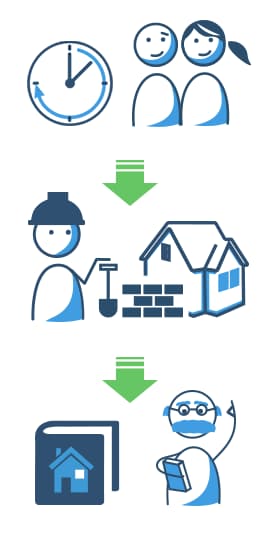
For consumers wishing to finance, and specifically those focused on financing a property, there are many advantages to this financing without own funds. A reserve no longer needs to be held for the financing, nor does saved money for emergencies need to be tapped to begin the financing.
Additionally, property buyers or builders no longer have to go the route of a Bauspar loan, but can instead immediately take advantage of favorable property prices to acquire ownership.
This means that prospective builders or families who need or want to acquire a property can make the decision to buy or build more quickly. Ancillary purchase costs for a property can, in addition to the construction or purchase price, also be financed with mortgage financing without equity.
Ancillary acquisition costs such as notary fees, land registry costs and other expenses can also be financed. Especially in times of low mortgage interest rates, full financing can be attractive because you can take advantage of favorable offers immediately.
Disadvantages for borrowers when financing without own funds

The drawback for borrowers of financing without own funds lies in the higher interest rates payable on the loan. With construction or purchase of a property without own capital, the burden during the repayment phase is significantly higher, although it can at least be partially offset by favorable interest rates.
Another requirement for financing without own funds is that a secure and financing-adequate income must be guaranteed, because banks only grant financing without equity in this case.
You may also be able to provide other securities that can reduce the interest rate.